
When the Light Turns Harsh
Mesquite Dunes is often the first stop for anyone new to Death Valley. It’s expansive, immediate, and undeniably grand. On the first morning of my recent workshop, that’s exactly why we started there. I wanted the group to feel the scale of the park right away, to stand in a place that makes you pause before you ever lift a camera.
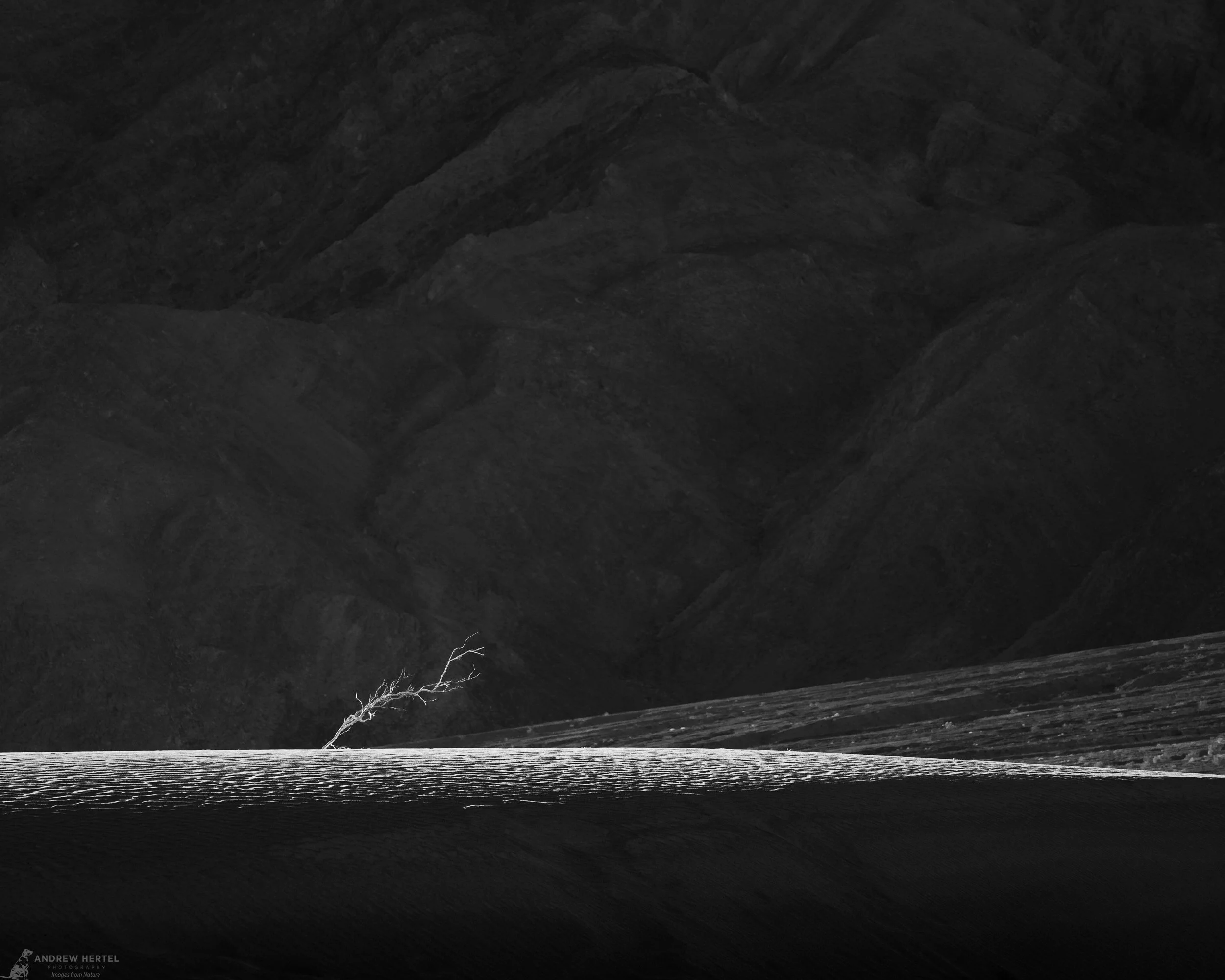
~Holding the Light~
We walked out onto the dunes in the predawn darkness, navigating by headlamp and memory. At that hour, the landscape is mostly suggestion. Shapes are hinted at rather than revealed, and it isn’t until the sun begins to rise above the surrounding mountains that the dunes slowly take form. This was a bonus session for those who arrived early for the workshop, a quiet introduction to the park before the day fully arrived.
As the sun rose, the soft light everyone hopes for didn’t last long. It rarely does in the desert. The contrast increased quickly, shadows tightened, and the dunes began to lose that gentle glow photographers tend to chase. This is usually the moment when cameras come down and people start packing up.
Instead, I turned around.
Behind us, the mountains were still wrapped in shade. That dark mass caught my attention, not as a subject on its own, but as an opportunity. I started looking for a place where the harsh sunlight and the remaining shadows could work together rather than against each other.
Across a nearby dune, a small honey mesquite tree stood just above the sand. Light streaked across the surface of the dune, illuminating the top edge and briefly catching it as if it had been placed there on purpose. The rest of the scene fell away into shadow. It was simple, quiet, and easy to miss if you weren’t looking for it.
One of the participants had mentioned the night before that they wanted to better understand how I see as a black and white photographer. This moment became a clear example. Once the “good” light is gone, I’m not waiting for it to come back. I’m paying attention to contrast, shape, and separation. I’m looking for tension between light and shadow, even when the conditions feel less than ideal.
Using a longer focal length allowed the background to compress into a darker, heavier presence. The goal wasn’t to erase detail, but to let the mountain act as a quiet wall of darkness, something the lighter dune and fragile mesquite could push against. The image depends on that weight. Without it, the scene loses its balance.
Minimalism often gets confused with emptiness. For me, the two aren’t the same. This scene isn’t about stripping things away until nothing is left. It’s about reducing the frame to what matters, while still allowing the place to feel alive and grounded. The mesquite, the ridge of light, the shadowed mountain. Nothing more than necessary, nothing less.
The desert doesn’t stop offering images when the light turns harsh. It just asks you to pay attention in a different way.
