
I won a photography award. So What?!
Some of my best images have come from plans that fell apart, and this one was no different. The conditions in Sequoia National Park that day had other ideas about where I was going. Heavy snow and questionable terrain have a way of making decisions for you, so I adjusted and stayed close to the Giant Forest Museum, walking through the forest and hoping the giant sequoias would give me something to work with against all that weather.
I love winter storms. Part of it might be that I live in San Diego where the weather is almost insultingly perfect most of the year, so when I find myself standing in actual weather it feels like a gift. Part of it is purely practical. Snow against dark trees is a black and white photographer's dream. And then there's the silence. A heavy snowfall has a way of swallowing sound and emptying trails, and I'll take that combination every time.
The snow was falling so thick I could barely see where I was going. Heavy wet flakes covered me and my gear, I couldn’t help but laugh at the absurdity of it a few times. I wasn't thinking about a specific shot, just moving through the forest, my eyes and mind open to possibilities, watching the sequoias appear and disappear through the storm.
Then I came around a corner and there it was, maybe thirty yards away. A raven, perched calmly at the base of one of the largest trees I'd ever stood next to, calling out into the storm telling the rest of the animals that I was there.
I brought the camera up, composed as fast as I could, and hit the shutter. One frame. Then it flew off and the forest went quiet again. I smiled to myself and continued trudging on through the snow, making fresh tracks.

I hoped the image came out, but honestly, regardless of the result, it was one of those moments where nothing else existed. The kind you carry with you long after the snow has melted and the drive home is a distant memory.
A few days later when I pulled it up on the monitor at home it brought me right back to that exact spot. Heavy wet snow on my face, the silence, that bird. And I knew immediately. This one was special. My smile was big and genuine.
That image, Sequoias, Snow and a Raven, went on to earn first place at Yosemite Renaissance 41. For those unfamiliar, Yosemite Renaissance is an annual juried art show that invites artists to create work inspired by the diversity of Yosemite and the surrounding Sierra Nevada. It's less about competition in the strict sense and more about celebrating that landscape through art.
Since I was making the drive up from San Diego anyway I decided to make a trip of it. I arrived a couple of days early, set up camp in Yosemite Valley, and spent two days just wandering. No real agenda, no pressure to come home with anything specific. Just walking around a place I know well and trying to find new ways to see it. That kind of time is rare and I didn't take it for granted.
It was my first time submitting to Yosemite Renaissance so walking into that gallery already felt like something. What struck me immediately was the range of work on the walls. This isn't a photography show, it's all kinds of art, painting, sculpture, mixed media, and somehow my photograph was sharing space with all of it. Talking with the other artists, hearing their stories and their process, I'll be honest, it made me feel like a real artist and a fraud at the same time. There was just so much talent in that room, and here I am, a knucklehead with a camera, but that’s a topic for another day.
When the awards ceremony started I got nervous fast. My name wasn't coming up in the early categories and I started doing the math. Welp, it was a fun trip anyways. Then they called my name for first place and I was genuinely shocked. Taking home first place was pretty unreal.
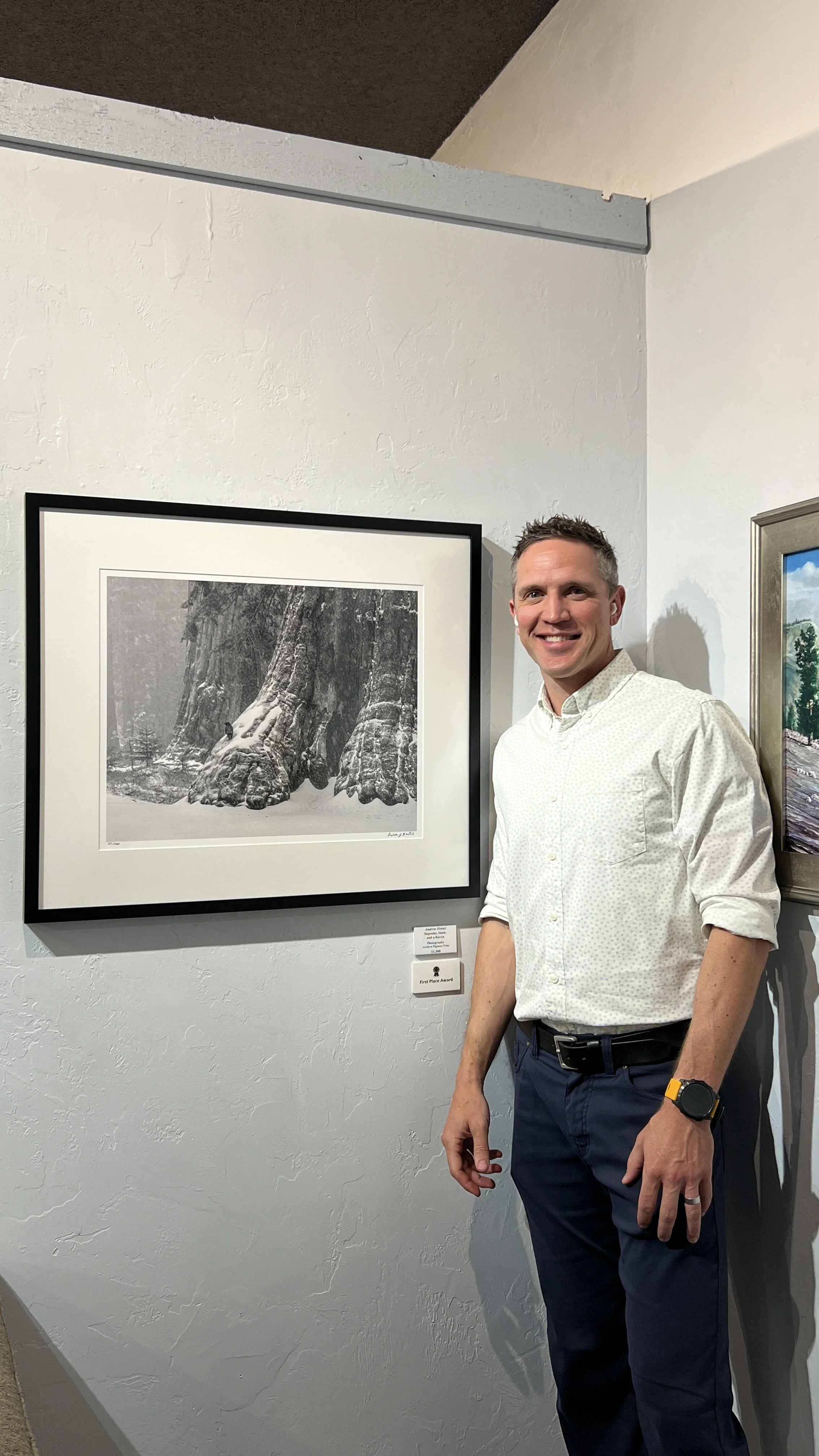
For a little while I just let it feel good. But then my brain did what brains do. What does this mean for me as an artist and for my work. Should I be charging more for prints now? Do I need to top this? Is every image I make from here going to be measured against a first place ribbon? I caught myself going down that road pretty quickly and had to pump the brakes.
Winning something doesn't make you a better artist overnight. It just means a handful of people responded to one image on one particular day. That's worth appreciating. It's not worth rebuilding your whole sense of self around.
About a month later the same image didn't survive the first round of judging in another competition.
My knee-jerk reaction was, F$CK them, I am human after all.
The notification came via email, which somehow makes it worse. A few lines of text to let you know that something you poured yourself into wasn't what they were looking for. I sat with it for about fifteen minutes, which is roughly my limit before I either spiral or do something about it. I was crushed. This is a competition I submit to most years and have even won before. I was genuinely excited about the idea of seeing that image on that wall too.
But the more I sat with it, the less it felt like a contradiction and the more it started to feel like something worth paying attention to.
I leashed up Sierra and headed out to the Tijuana River Estuary, a stretch of walking paths and marshland near my house in southern San Diego. It's a unique little place. Birds everywhere, rabbits darting through the brush, the ocean close enough that you can hear it and smell it even when you can't see it. Some sections get marshy and wild feeling. It doesn't look like much on a map but I've learned to really love it out there, I don’t feel like I’m in San Diego but somewhere out in true nature.
Sierra did what she always does, walked beside me and sniffed absolutely everything. I just walked, breathed in the fresh air and let my mind wonder.
There was no single moment where something clicked. That's not really how it works, at least not for me. Time in nature just has a way of removing the noise and letting your brain be rational again. By the time we turned back toward the car things felt a little clearer.
The two competitions were simply asking different questions of the work. Yosemite Renaissance celebrates the beauty and diversity of the Sierra Nevada through art. Story, atmosphere, and emotional resonance carry real weight there. The other competition, while it values those things too, leans more heavily on technical precision. And when judges are looking at thousands of photographs, they need criteria that help separate one image from the next.
Neither approach is wrong. They're just different questions.
What the experience gave me was clarity about what I value most in my own work. When I'm out in the field and I come across a scene I want to photograph, the first thing that has to happen is I have to feel it. It's hard to describe exactly. I see it, I feel it, and I just know. I'm not running through compositional rules or technical checklists in my head. I find the scene and then figure out how to make a compelling image from it.
Sometimes that means sacrificing technical perfection for emotional truth. In this particular image there was very little light because of the heavy snowfall, so I shot at f8 and pushed the ISO to 1000, neither of which would be my first choice under different circumstances. I would have preferred f11 for a little more depth of field and ISO 100 for cleaner image quality, but I was shooting handheld in a storm with a bird that had no intention of waiting around. The result is that the corners of the image are slightly soft. Not tack sharp from edge to edge the way judges in a technical competition might want. Maybe I would’ve framed the shot a little different with the luxury of time. But if I had stopped to set up a tripod and dial everything in, the bird would have been long gone. And without the bird, the image of the trees is pretty. Just pretty. Nothing more. No emotion, no soul, for me anyways.
I think I've always worked this way. In the beginning when I was still learning the technical side of photography I paid more attention to it out of necessity. But once you internalize the technical stuff and it becomes automatic you stop thinking about it so much and can focus on what actually matters. The story. The feeling. The reason you raised the camera in the first place.
I've had a love-hate relationship with competitions for a long time. A few people who have never stood in that storm, never felt the snow on their face, never knew the backstory, are ultimately deciding whether the work advances. Recognition feels good, of course it does. But I've found it's hard to maintain a healthy relationship with your own work when it’s being measured against a scorecard by strangers working within a box.
I've been playing hockey since I was a kid and still play in a men’s beer league. The two worlds couldn't be more different. Hockey is where my competitive side gets to run loose. Photography is where my art brain gets its exercise. On the ice the scoreboard tells you exactly where you stand at all times. There's no ambiguity, no interpretation, no room for debate. You either scored enough to win or you didn't and lost.
Art doesn't work that way.
When judges are scoring an image, there's no column for backstory. No column for the emotional weight of a moment. No column for the years it took to develop the instinct to recognize a fleeting raven beneath a snow-covered sequoia and respond before it disappeared. No column for the fact that the corners are slightly soft because I made a conscious choice to be present instead of perfect. There’s no column for “I wish I could move left, but I’d fall off this cliff if I did”.
Connection and story matter to me. More than ISO settings or whether every pixel is tack sharp from corner to corner. Technical craft matters, yes, but at some point the story is what carries the image.
I haven't lost faith in competitions entirely. But this experience has made me more intentional about where I put my energy. There's a difference between a show like Yosemite Renaissance, which exists to celebrate a specific landscape and the art it inspires, and a general photography competition where thousands of images get a few seconds of attention from judges who have never stood anywhere near the place you made the photograph and can’t ask the photographer about the process of making the image. I think I'll keep seeking out the former and be a lot more selective about the latter.
And if you're reading this because you didn't get in somewhere, or your image didn't advance, I want you to hear this. It may not be your art. It may be the wrong competition, the wrong category, the wrong judges, the wrong year. A rejection isn't a verdict on your work. It's just one answer to one question on one particular day.
I'm not trying to figure out if my work is good enough.
I'm figuring out where it belongs.
And if an image makes me smile, brings back a memory, or makes one person feel something, that's the real win. Everything else is just information.
As always, thanks for following along and keep seeking the extraordinary in the world around you.
~Andrew
