
It’s Okay to Be Different : Finding My Vision in Black & White

A visit to Antelope Canyon changed the way I see and really ignited my sense of awe and wonder for the natural world.
Creativity rarely begins where we expect, it often sneaks up on us in the most ordinary moments.
It’s Okay to Be Different (In Fact, I Encourage It!)
We all start somewhere, usually with more curiosity than confidence. For me, photography didn’t begin as a grand artistic pursuit; maybe it was my way of rediscovering that same sense of wonder I had flipping through my grandparents’ magazines and books as a kid. My first camera came as a hand-me-down gift in my late twenties, and at that time I had no idea what I was doing. The images were terrible, I had never used anything other than a disposable camera, and I didn’t have much time to learn anyway. I was busy building a new life and career after moving to the West Coast from my roots in the Midwest. Several years later, after leaving Los Angeles and settling into San Diego with a corporate job, I was finally able to buy a newer camera to take along on hikes and adventures. That’s when things began to change. I fell deep into the rabbit hole of photography, driven by curiosity and a desire to understand the craft. My grandparents had stacks of National Geographic magazines and bird books that I would flip through every time I visited, and those pages must have planted a seed that was finally starting to grow. I never dreamed of being one of “those” photographers, it felt completely out of reach for someone like me, a kid from a small town in the Midwest learning how to be an artist as an adult. But that spark of curiosity slowly evolved into something much more, and eventually into a love of seeing the world differently.
When I first picked up a camera, it felt like the natural next step in that growing curiosity. I didn’t consider myself an artist. In fact, I had to learn what being an artist even meant. The artistic part of my brain was buried under years of structure, rules, and competition. Art didn’t come naturally to me, I had to learn how to see, how to feel, and how to let go of trying to control everything. Over time, photography became the way I discovered that side of myself. I realized that the artist had always been there; it just took the right medium and the right kind of patience to bring it out. Photography has changed how I see the world, and I love it.
Those early years were full of experimentation and frustration. I photographed everything that caught my eye. It was a process of trial, error, and a lot of deleting. I never took a photography class or had a mentor. I learned through books, YouTube, and time spent outdoors, failing and trying again. Instagram was just taking off, and I remember seeing all the colorful, popular images getting thousands of likes. Naturally, I wanted that too, not just the likes but the “perfect” images I saw. I tried to make the kind of photographs everyone else seemed to love: beautiful sunsets, glowing skies, ethereal landscapes, the kind of work that was sure to get attention. I suppose I thought that was what good photography was. But it never quite felt like me. Looking back, I think that’s when I first started to realize that being different might actually be my strength.
Even back then, I was drawn to black and white. It wasn’t trendy, and it certainly didn’t rack up likes, but something about it felt right. I couldn’t explain it at the time, it just made sense to me on a deeper level. Still, I kept chasing the crowd for a while, trying to fit in with the so-called cool kids of the photography world, until a ski trip to Jackson Hole in 2020 changed everything.
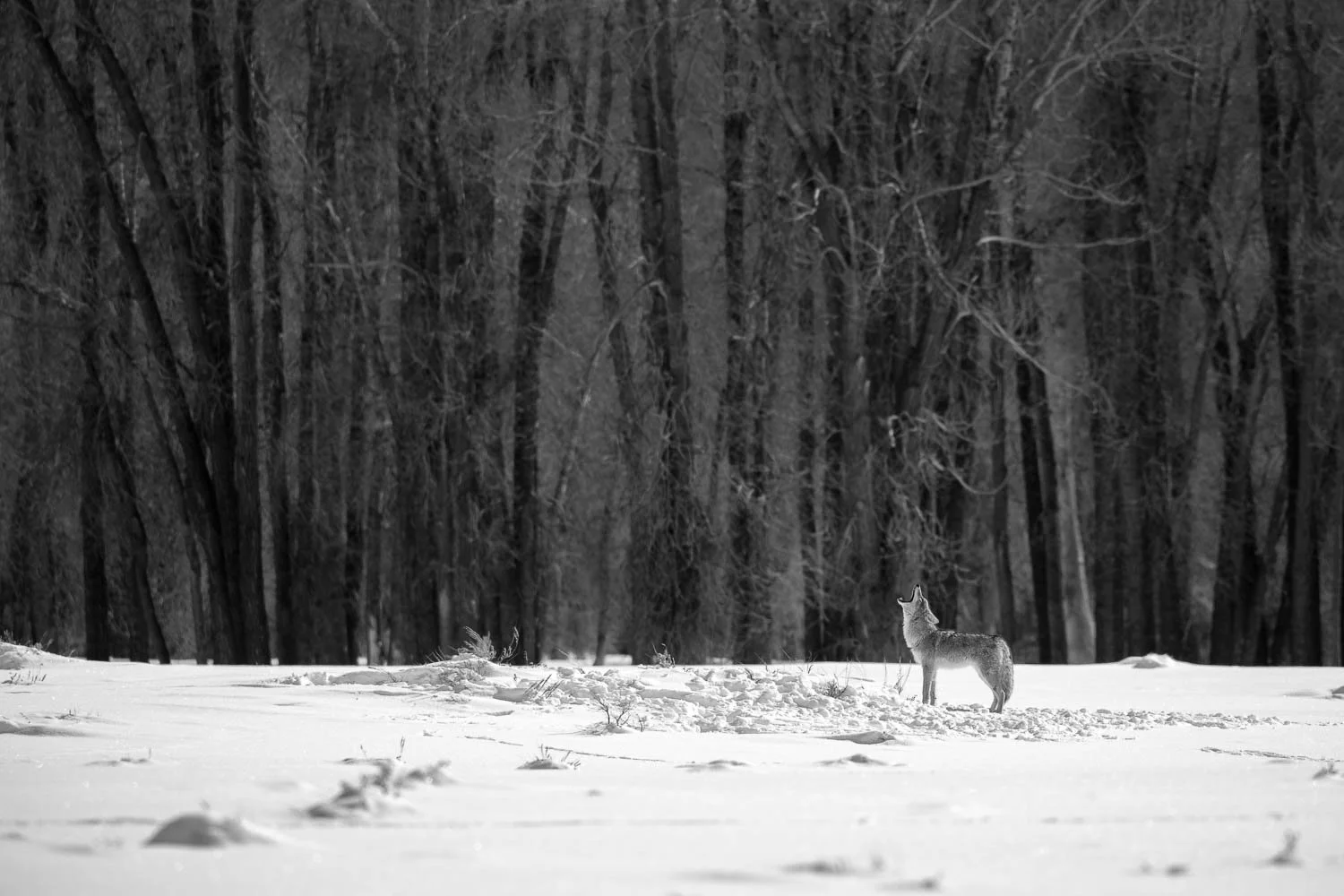
~Ballad of the Coyote~
At that point, I had been wrestling with what kind of artist I wanted to be, trying to balance technique with emotion and searching for direction. Maeve and I were there for a few days, and I took one day for myself, a day to explore, photograph, and be alone in nature with my vision and my camera. That’s when I encountered a lone coyote in the Grand Tetons. The time I spent with that animal became one of the most meaningful experiences of my life. The photograph I created, Ballad of the Coyote, became a turning point. It wasn’t a rare animal or a dramatic moment, but it was honest and deeply personal. Even while I was there, I knew the image would be black and white, I had recently made a shift to following my passion of black and white photography and fully committing to that path. That image reminded me why I love photography, because it connects me to nature in a way nothing else can. It also became one of my best-selling pieces, which I think says something about authenticity in art.
While I was there, with my big lens in hand, people stopped to ask what I was photographing. When I said, “that coyote,” I could see the disappointment in their eyes before they drove off. One guy even said, “We shoot those for fun where I’m from.” I almost said something I’d regret, but instead, I turned back to my camera and stayed with the coyote. We spent nearly two hours together, quietly sharing space. That day reminded me that being an artist isn’t about making other people happy, it’s about noticing what others overlook and allowing yourself to care deeply about it.
That shift from structure and control to creation was not an easy one. It marked the beginning of a new mindset focused on observation and creating rather than achievement.
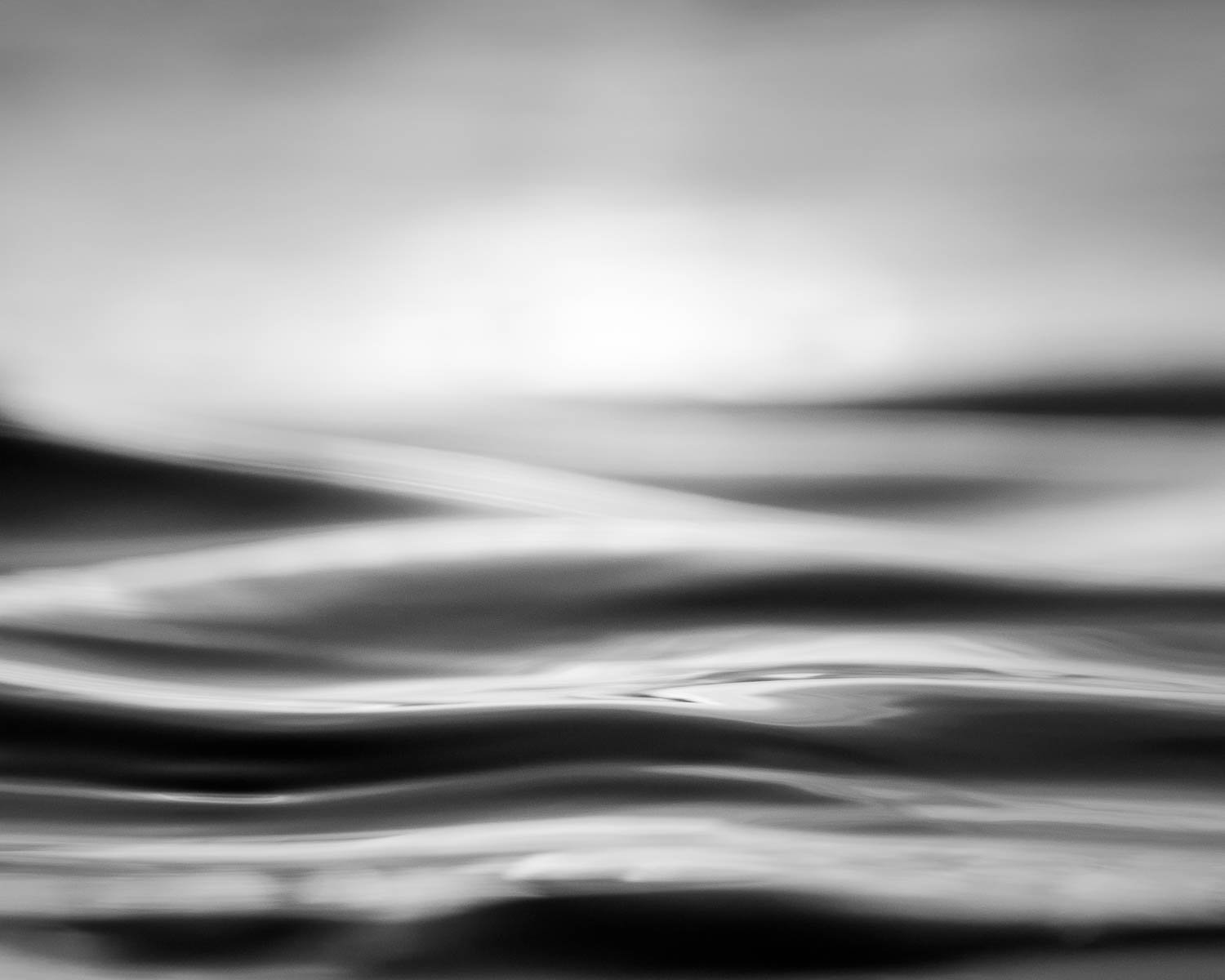
~On The Surface~
I grew up a hockey player. You either won, or you lost. There was always a scoreboard telling you exactly where you stood. Art doesn’t work that way. There’s no finish line, no opponent to beat, no clear metric for success. It took years to unlearn that win/lose mindset. Becoming an artist meant embracing uncertainty and learning to trust that feeling, rather than facts or scores, would guide me forward. It’s still something I work on every day. This was no easy task when the only way to measure my “worth” as an artist was likes and followers on social media. I was a nobody starting out on a lonely path, but stubbornness kept me moving forward.
Letting go of that competitive mindset opened up space for me to discover my own individuality and trust what felt authentic.
Now, I embrace what makes me different. My booth at art shows looks a little different too. For one, I'm usually the only black and white photographer at most shows. My work is quiet and contemplative, there are no loud colors calling passersby into my booth. Front and center, I always display my large acrylic print of Antelope Canyon No. 1. Most people recognize the location from brilliant, colorful photos they’ve seen before, but mine is pure black and white. The light, shapes, and textures drew me in far more than the reds and oranges ever could. It stops people in their tracks. They say, “I’ve never seen it like this,” and I smile, because that’s exactly the point. Seeing differently and connecting with what others might miss is what makes it art.
After sharing the story behind Antelope Canyon No. 1, it’s easy to see how it reflects the same spirit of independence, it’s a visual reminder that following your instincts can lead you down your own artistic path. That photograph, like the coyote image, taught me that difference isn’t about standing out for attention, it’s about quiet conviction and being true to my inner voice.
~Antelope Canyon No. 1~
During a recent trip to Utah to visit my friend Seth, I had another reminder of why I see things the way I do. One day, while he was working guiding clients, he sent me to one of his secret slot canyons, the kind of place that makes you feel like you’ve stepped into another world. The light was perfect, the contours and textures of the sandstone were stunning, and I had the whole canyon practically to myself.
Of course, I made plenty of photographs of the dramatic shapes and light, how could I not? But what stopped me and held my attention the longest wasn’t the sweeping forms or glowing walls. It was a small, quiet moment: a few golden leaves that had fallen from a tree perched high above, resting gently on the canyon wall. I spent nearly an hour with that single scene, shifting just a few inches at a time, exploring different frames and compositions, completely absorbed in the patterns and textures.
That little cluster of leaves reminded me, once again, that being different isn’t always about photographing what others overlook, sometimes it’s about slowing down enough to see what others pass by. Those quiet moments, the ones that stop you for no reason other than they feel right, often hold the most meaning.


Being different doesn’t automatically mean good, or even better. It just means you. The real challenge is learning to be deliberate with your differences, to understand why something speaks to you and to create from that place. Finding your own vision takes time, patience, and a willingness to explore without chasing approval. That’s where the real growth happens, not in being unique for its own sake, but in being honest with yourself about what feels right.
For me, being different isn’t about doing something no one else has done, it’s about how I see and feel the world. My difference lies in quiet observation, choosing simplicity over spectacle, and trusting that emotion can be as powerful as color. I’m not chasing perfection or trends; I’m chasing honesty. That’s what sets my work apart, and it’s what keeps me curious.
Being different takes courage. It means standing apart from trends and sometimes from approval. It means trusting your instincts when the world tells you otherwise. Social media can make this especially hard, it rewards repetition and trends, not originality, unless you have a huge audience already - then you can do whatever you want. But I’ve learned to measure success differently. I post when I have something meaningful to share, not because an algorithm says I should. My images don’t have color. My feed isn’t perfectly curated. But my website, that’s my portfolio, the place where my work lives the way I intend it. Someday I hope to have my own gallery, but until then, I’ll keep showing at art fairs, meeting people in person, and having real conversations about art, nature, and what it means to follow your own path.
If there’s one thing I want people to remember, it’s that being different isn’t just acceptable, it’s something to celebrate and embrace. The moment you stop creating for approval and start creating from the heart, that’s when you find your voice. Whether it’s a photograph of a quiet desert dune, a poem only you understand, or a song that never leaves your living room, make it yours. If it feels uncomfortable, even vulnerable, you’re probably closer to something real than you think.
Creativity rarely begins where we expect, but it always finds those willing to see the world in their own way.

Until next time, keep seeking the extraordinary in the world around you.
~Andrew
